Blog
A Passion For Paper
4/26/2021 4:23:26 PM | By Michael E. Vermette | 1 Comment

Photo of Michael E. Vermette at Churchill Dam Allagash bWilderness waterway. Photograph by Troy Sands
A PASSION FOR PAPER
By
Michael E. Vermette
For 50 years of my life I have pursued a passion for watercolor paper. I love the feel of it, the smell of it, even holding a sheet of watercolor paper up to the sunlight and admiring the leathery “Grain” especially with handmade papers. Lately, I have been able to acquire a lot of J. Whatman vintage watercolor paper with the help of my patron and through an artist in his 90’s. He was willing to sell me the paper because he was looking for someone who would appreciate painting on it as he had throughout his life. He told me that his father bought the paper for him in England in 1950. Hoping to keep these papers out of a paper museum I was able to pay what the papers are worth in auction at $150.00 per sheet. They were 19 sheets of 1958 Whatman Antiquarian 27 x 40 inches, 13 sheets of 1936 Whatman Double Elephant 30 ¾ x 57 ½ inches and 10 Whatman Imperial 1948 and 1959 22 ½ x 31 sheets. So as you do the math just keep in mind just how serious my search to find the perfect watercolor paper to paint on has become.
The Whatman watercolor paper that I am talking about is not what you can buy on the market today. In fact the mill was cleared and demolished in 2018 and is now a housing estate. James Whatman invented wove watercolor paper at Turkey Mill in 1750s and it was a breakthrough from laid papers of the time. Between 1930s to the 1960s Whatman created over 300 different types of handmade paper for writing, record keeping and watercolor painting. This is amazing when you think of just how much work goes into manufacturing just one kind of watercolor paper today. Handmade Whatman watercolor paper was discontinued in the mid 1950’s and mould made paper manufacturing ended in the mid 1960s. Like many other high quality art materials of the past, papermaking one sheet at a time by hand became non viable. You might say that they couldn’t pay young men enough to stand in water all day to pull the valuable sheets and as a consequence the recipe was lost.
What I do with my vintage paper? First, I presoak the paper 5 to 15 minutes and stretch it on an oil painting stretcher frame as you might a canvas. I do this so that I can access and wet the back of the page before I paint on the surface. This wetting-of-the back of the page in my initial washes acts to draw them into the sized page evenly giving a soft edge and making your watercolor paints 20% to 30% brighter and more alive! By drawing the washes into the paper it also makes a more interesting grain (Leathery wove of the inner paper as well as the surface).
The other quality I like about using vintage Whatman watercolor paper is that it is simply the best watercolor paper ever made! Why? Because it has all the best qualities found in all of the papers on the market today and even more, all in one paper. It lifts almost 100% of the wash laid down even after they are is dried. It yields more color than some papers that understate color when drying. It is also a very tough paper that will not tear when you pull the tape, if you tape your edges as I do. Above all it will accept many washes and glazes without creating mud, as with the complicated subtractive techniques brought to the highest level by J.M.W. Turner who worked regularly on Whatman. This paper withstood the rigors of this experimentational master watercolor painter.
The other thing I do with these papers is add a chalk ground that I texture myself. The formula is easy to make and is similar to the ground used to make the traditional watercolor canvas that Paul Ce’zanne was known to paint his watercolors on. I use 12 parts of China Clay to 1 part of rabbit skin glue and mix and heat it up in a double boiler with water to the consistency of yoghurt. Then I apply it to pre-drawn areas that I want to pop visually. But I don’t paint the whole sheet. I also tool and texture the ground while it is wet and sand it when it is dry to create new textures different from the organic grain of the watercolor paper. It dries whiter than the paper, so it is very easy to find on the paper. It is also very archival and acts like painting on a Yupo watercolor paper, Therefore it needs to be painted directly and without a lot of fuss, but what you get is another surface that will contrasts the organic makeup of the paper.
The following are examples of my larger watercolors that utilize the vintage Whatman papers that I have been having a lot of success with. I hope you have enjoyed my sharing. If you would like to learn more of the process of how I stretch my watercolor paintings or make my chalk ground go to https://www.michaelevermette.com and click on “Artist Instruction.” If you would like to view more of my work in my galleries click on “Works.”

"Alagash Rangers Shooting Chase Rapids" a watercolor on elephant size vintage
Whatman handmade watercolor paper 30 1/4 x 57 1/2 inches by Michael E. Vermette.

"Sea Dog" a watercolor on vintage 1936 Whatman Watercolor paper 27 x 40 inches
by Michael E. Vermette.

"Changing Course, Monhegan Island" a watercolor on vintage 1936 handmade
Whatman watercolor paper 30 1/4 x 57 1/2 inches by Michael E. Vermette.
ART SPIRIT STUDIO Earth day Edition April 22nd, 2021
4/22/2021 7:54:59 PM | By Michael E. Vermette | Comment on this
|


ART SPIRIT NEWSLETTER Second Look Spring Art Sale April 13th, 2021
4/13/2021 12:42:38 PM | By Michael E. Vermette | Comment on this
|
ART SPIRIT NEWSLETTER Second Look Spring Art Sale April 13th, 2021 |
|
|
A Second Look, Spring Art Sale/Auction The following paintings are currently on eBay's Auction. I decided to host a second chance Spring auction that would first include many of the watercolors I posted last Winter and even some new ones. I will also post some of my oil paintings and some ones that have not been seen for a while as I go through my inventory. So Enjoy the work and bid if you have to have them!
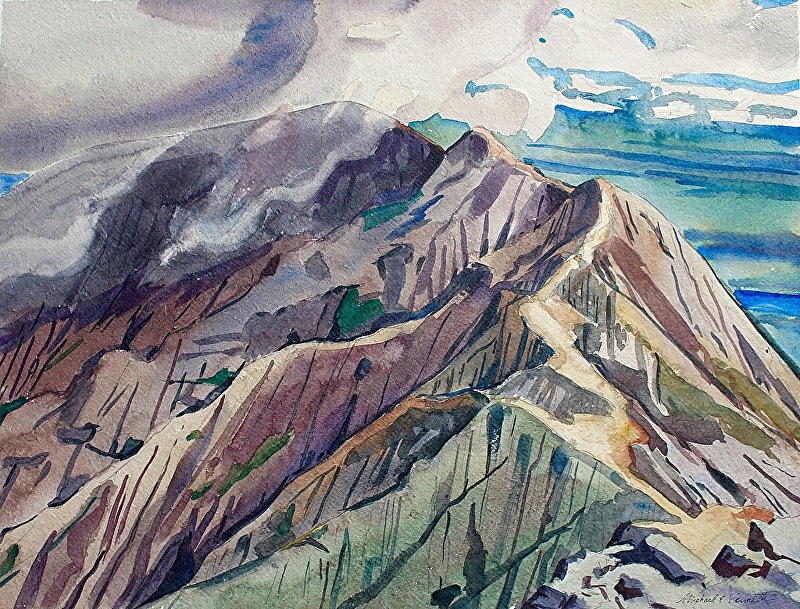
"The Knife Edge From Baxter Peak, Baxter State Park, Maine"
Michael says, "This painting was painted in my studio from photographs taken by myself from a hiking trip I made with a group of friends to Baxter Peak. The day before we were trapped by the runoff of three days of continuous rain. Multiple waterfalls poured down from the mountain and trails were flooded up to our waists with wild flowing current that made descending the mountain impassable. The following day all the water held up at Chimney Pond flooded Basin Pond and Roaring Brook. As some hikers navigated there way down the mountain, we climbed up to the summit. The weather broke and the sun broke through as I took multiple photos from the summit of Katahdin. We chose Saddle Trail up across to the Katahdin Peak, cross the Knife edge and down the old Dudley Trail. The day after that we were able to hike down the mountain with little problem. The ranger said it hadn't rained like that in 20 years and even today it was one of the wildest mountain hikes I ever experienced."
|
|

|
"Monhegan Headlands in the Fog, Maine"
|
|

|
"Moxie Falls, Kennebec Valley, Maine"
|
|

|
"Helon Taylor Trail, Baxter State Park, Maine"
Michael says, "In this painting I wanted to paint Katahdin from the view of the Helon Taylor Trail, named after a celebrated former Baxter State Park supervisor. It's 3.1 mile path is entwined with rocks and roots that get bigger as it reaches tree-line, exiting the trees and beginning the long ascent up Keep Ridge, where most of the Helon Taylor's 3,413 foot elevation is depicted as in my watercolor. I chose this winding mountain composition because it appears as if the hiker is ascending up the trail into the clouds. This is also chosen by hikers as one of the most spectacular trails in the Northeast."
|
|

|
"Otter Cliffs in the Afternoon, Acadia National Park, Maine"
|
|

|
"Gibbs Falls Cascade, Crawford Notch Trail, White Mountain National Forest, NH"
Gibbs Falls is located in Bean's Grant New Hampshire, which is located in Crawford Notch within the White Mountain National Forest. Gibbs Falls is a small cascade a short distance up the Crawford Path, which, originally was created in 1819, and is the oldest maintained hiking trail in the country. Gibbs Falls has a 35 foot total drop, not a very steep waterfall but more of a small cascade.
Michael says, "The beautifully light-sandy rock colored Gibbs Falls is really a splendid cascade from which to view and paint en plein air a watercolor at its shallow base. It holds a vast array of color with graded tonal twists and turns that create a magical sense of place in the woods.To visit it requires a walk of little more than half a mile on moderately steep terrain. I started hiking on Crawford Connector, which leaves at the far end of the parking area, crossing Mt. Clinton Road in 0.1 miles. It begins to ascend on the other side, climbing to a wooden bridge over Gibbs Brook, the water source of the falls, in another 0.3 miles. It joins the brook and climbs more steeply alongside it for 0.2 miles, where a spur leading down to Gibbs Falls appears. Then I turned left and walked a short distance to the shore of the shallow pool below Gibbs Falls, a narrow, angled waterfall which always flows through a well-defined rock path. What an amazing place to paint."
|
|

|
"Upper Small Falls, Rangeley, Maine"
|
|

|
"Small Falls, Rangeley, Maine"
Thank you for viewing my Paintings! Michael E. Vermette |
Topics
Archives
Recent Works |
|||

|

|

|

|

|

|

|

|
